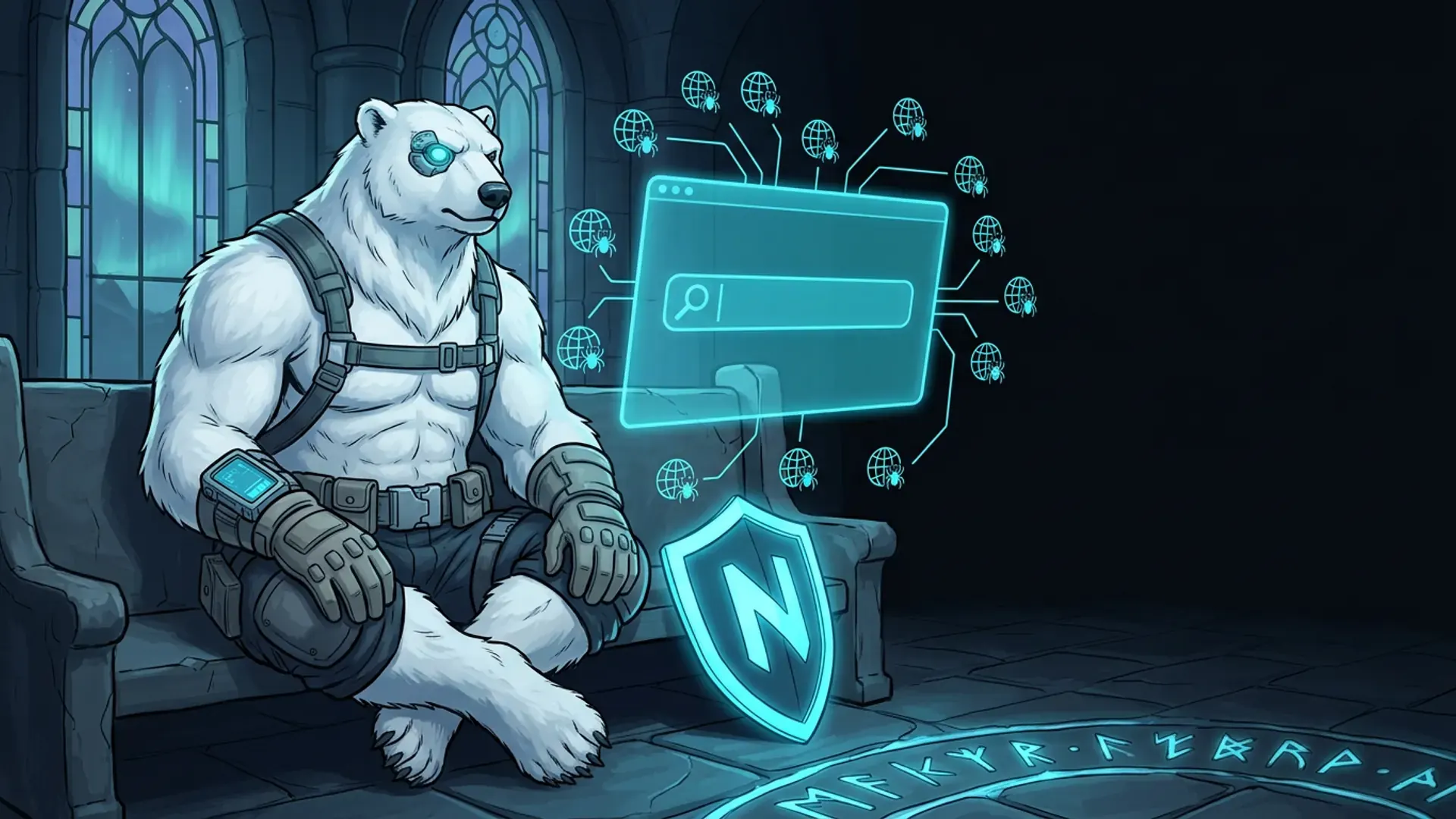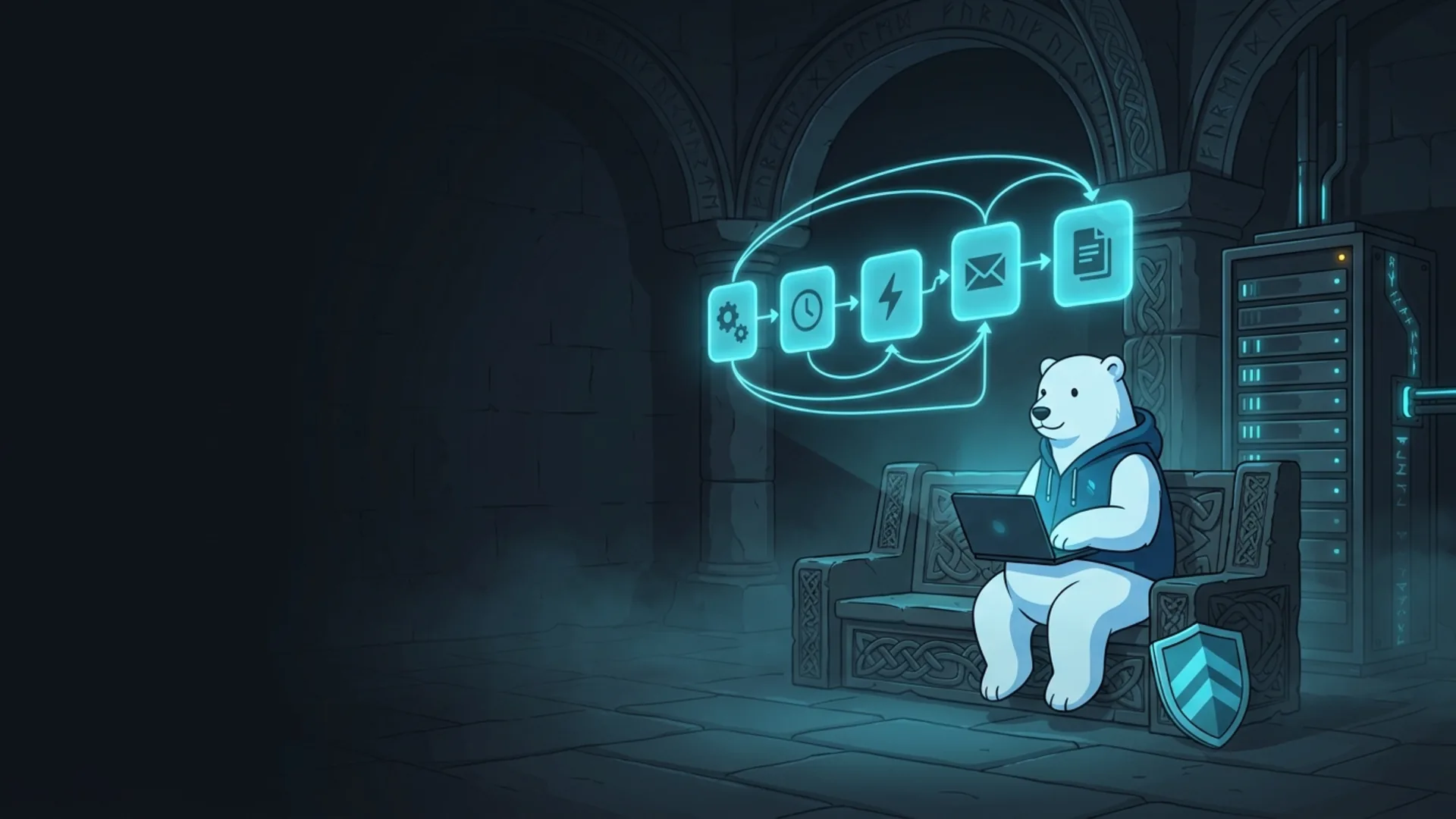
La mascotte orso polare di NordBastion seduta centralmente in uno scriptorium nordico in pietra con sei rotoli olografici ciano fluttuanti disposti intorno a lui, lo scudo-N ciano appoggiato accanto alla panca, alte librerie ad arco e finestre con vetrate colorate sopra
Guide · Redatto, documentato, datato

Il manuale sul campo del privacy hosting.
Scritto dall'host, non dall'affiliato.

Ventotto guide lunghe e approfondite su hosting VPS anonimo, pagamento in criptovalute, postura no-KYC, giurisdizione nordica, backup offsite cifrati, runtime per agenti IA e MCP, modelli linguistici locali, e self-hosting dello stack per la privacy — un checkout BTCPay, una forge Git, una mesh VPN Headscale, analisi web senza cookie, Vaultwarden, Nextcloud, un server di posta, Matrix, SearXNG, n8n, un nodo Monero, un resolver DNS privato, Tor, WireGuard, Bitcoin Lightning, Mastodon. Nessun link di affiliazione, nessuna lista «il meglio di», nessuna menzione sponsorizzata — solo le domande che un cliente attento farebbe davvero al proprio host.

Regole editoriali · Come scriviamo

Tre regole. Le stesse in ogni guida.

01 Verificato

Citare lo statuto, non lo slogan.

Le affermazioni legali sono legate a statuti nominati (Tryckfrihetsförordningen, Sananvapauslaki, Articolo 100, IMMI), le raccomandazioni sui wallet sono legate alla documentazione del wallet, le affermazioni sulla rete sono legate agli RFC e alla pratica degli operatori. Se non possiamo citarlo, non lo affermiamo.


02 Nessun affiliato

Nessun ricavo dalla raccomandazione.

Nessun link a wallet, exchange o host peer in queste pagine è un link di affiliazione. Se una guida dice «usa Feather», è perché Feather è il wallet giusto, non perché riceviamo $7 ogni volta che qualcuno lo installa. Lo stesso vale per gli host peer nelle pagine /compare/.

03 Datato, rivisitato

Ogni guida riporta una riga di ultima revisione.

Le interfacce dei wallet crypto cambiano, gli statuti vengono emendati, le topologie di rete si modificano. Ogni guida mostra la data dell'ultimo controllo dei fatti. Se una guida non è stata revisionata in dodici mesi, riporta un avviso di dati obsoleti in cima.

La libreria

Ventotto guide, in ordine di lettura.

Iniziare dal pilastro se si è nuovi all'hosting privacy. Passare direttamente alle guide sul pagamento se si sa già cosa si vuole. Il riferimento sulla giurisdizione nordica è per il lettore attento che vuole leggere lo statuto. Le guide sul self-hosting assumono che il VPS sia già provisioning.

01 · Pillar · 12 min read

Anonymous VPS hosting — the 2026 pillar guide

A complete walk-through of what "anonymous" actually means for a virtual private server: the three independent layers (signup, payment, network), the legal frame around each, the operational mistakes that quietly de-anonymise a server, and the questions that separate a real KYC-free host from a marketing-only one.

Legga la guida
02 · How-to · 8 min read

How to pay for a VPS with Monero — step by step

Five steps from "I have never used Monero" to "my Stockholm VPS is booted and paid for in XMR" — pick a wallet, acquire XMR, scan the panel QR, wait for the network confirmation, order a server. Tested on Feather, Cake and the official Monero GUI.

Legga la guida
03 · How-to · 9 min read

How to pay for a VPS with Bitcoin and Lightning

Bitcoin on-chain is settled in about ten minutes; Lightning is settled before you finish reading the QR. This guide covers both — when to use each, how to top up from a self-custodial wallet, and how to handle the rare LN-channel routing failure.

Legga la guida
04 · Explainer · 10 min read

No-KYC VPS hosting, explained

What KYC is, why most hosts require it, why a small slice of the market deliberately does not, what the legal status of KYC-free hosting actually is, and how to read a "no-KYC" promise critically — including the four questions that tell you whether a host means it or is just marketing.

Legga la guida
05 · Reference · 14 min read

The four Nordic jurisdictions, for hosting

Sweden, Finland, Norway and Iceland — four constitutional press-freedom regimes, each with a different shape. This guide is the deep-dive: the actual statutes, the actual case-law, the actual reachability by EU/US legal process, and what each one means for a server sitting inside it.

Legga la guida
06 · How-to · 15 min hands-on

WireGuard VPN on a VPS — self-host your own personal VPN

Five steps from "no server" to "my own personal VPN" — KYC-free signup, crypto-paid, no third-party VPN provider in the trust chain. Tested on Debian 12 with WireGuard 1.0+ in the mainline kernel. The trust chain shrinks by one party; the cost stops being a $15/month subscription.

Legga la guida
07 · Guida pratica · 20 min

Tor hidden service on a VPS — self-host a v3 onion

Five steps from provisioning a Nordic VPS to a live, 56-character v3 .onion address reachable only through Tor. Two lines in torrc, server-banner stripping, Vanguards-lite, and Onion-Location auto-redirect on the clearnet companion.

Legga la guida
08 · How-to · ~3h hands-on (mostly IBD)

Self-host a Bitcoin Lightning node on a VPS

Bitcoin Core + LND (or Core Lightning) on a KYC-free Nordic VPS — pruned or full, Tor-routed, BTCPay-ready. The complete walk-through from picking a tier through opening the first three channels, with the channel-management caveats nobody mentions until you hit them.

Legga la guida
09 · Guida pratica · 90 min

Self-host Mastodon on a VPS — fediverse on owned metal

Six steps to your own Mastodon instance, federation-ready, on Ravelin tier. Docker Compose, anonymous domain registration paths, SMTP relay trade-offs, TLS via Let's Encrypt, and the closed-vs-open registration decision you should make on day one.

Legga la guida
10 · Guida pratica · 30 min

Self-host Vaultwarden (Bitwarden) on a VPS — your own password manager

Vaultwarden is the lightweight, Rust-based, Bitwarden-compatible password server. Five Docker commands, one HTTPS reverse proxy, one backup cron — and the credential vault of every account you own lives on metal you rent. Plus the metadata layer: why a KYC-free host matters for a password vault even when the contents are client-side encrypted.

Legga la guida
11 · Guida pratica · 90 min

Self-host Nextcloud on a VPS — your own private cloud

Nextcloud is the open replacement for the Google Workspace stack — file sync, photo backup, contacts, calendar, collaborative documents, end-to-end encrypted chat and video. The All-in-One Docker install, mobile sync, Office Online, Talk, S3 external storage, the backup story and the Nordic jurisdiction angle.

Legga la guida
12 · Guida pratica · 3h

Self-host a mail server on a VPS — Mailcow vs Mail-in-a-Box vs iRedMail

Self-hosted email in 2026 is gated on three brick walls — outbound port 25, IP reputation, PTR alignment — before any software is installed. The three serious stacks compared, the DNS records that must align perfectly, the warm-up period at Gmail and Outlook, and the no-KYC host that opens port 25 by default.

Legga la guida
13 · Guida pratica · 2h

Self-host Matrix (Synapse + Element) on a VPS — your own encrypted chat

Matrix is what email would look like if it had been designed for chat in the open-protocol era. Synapse as the homeserver, Element as the client, PostgreSQL as the store, federation enabled, end-to-end encryption by default — and the metadata-layer reasoning for why the host the homeserver lives on matters.

Legga la guida
14 · Guida pratica · 20 min

Self-host SearXNG on a VPS — your own private metasearch engine

SearXNG fans queries out to 70+ upstream search engines without forwarding your IP or identity. Three Docker commands, one reverse proxy, the IP-reputation wall that makes hyperscaler IPs fail, browser-default integration on desktop and mobile, and the Perplexica AI-search front-end that turns the whole thing into a private ChatGPT-search analogue.

Legga la guida
15 · Guida pratica · 60 min

VPS hardening — the first-hour OPSEC checklist

Eight concrete steps to harden a fresh Nordic VPS in under one hour — SSH key-only, custom port, firewall baseline, unattended-upgrades, fail2ban, snapshot, recovery doc. The universal pre-launch checklist before any workload goes live, regardless of what the workload is.

Legga la guida
16 · Guida pratica · 40 min pratici

Come ospitare un server MCP remoto in modo anonimo

Sposta il tuo server MCP da localhost a un VPS pubblico senza KYC: scegli un piano, installa il tuo server, mettilo dietro TLS, esponi l'endpoint streamable-HTTP, aggiungi OAuth e ospita l'agent card. Pagato in crypto, senza alcun documento d'identità in nessun punto della catena.

Legga la guida
17 · Approfondimento · 12 min di lettura

Hosting MCP senza KYC — distribuisci un server MCP senza documento

Cosa sia davvero l'hosting MCP senza KYC, perché l'infrastruttura degli agenti AI non dovrebbe portare la tua identità, e come distribuire un server MCP su un VPS nordico senza KYC pagato in crypto — nessuna verifica email, nessuna carta, nessun documento.

Legga la guida
18 · Guida pratica · 25 min pratici

Esegui un agente AI 24/7 su un VPS — senza KYC, pagato in crypto

Le quattro modalità di guasto che impediscono a un agente di vivere su un laptop, poi il runtime che le risolve: dimensionare la macchina alla forma dell'agente, restart policy di systemd e Docker, la trappola del crash-loop, segreti che non devono mai raggiungere l'immagine, pianificazione, tetti di spesa — e cosa protegge, e cosa no, un host senza KYC.

Legga la guida
19 · Guida pratica · 30 min

Self-hosting di un LLM su VPS — Ollama su CPU, senza GPU

Self-hosting di un LLM sul suo hardware, senza scheda grafica e senza chiave API. La divisione che prevede i token al secondo prima di comprare la macchina, quale modello entra in 4, 8, 16 o 32 GB di RAM, l'autenticazione che Ollama non include e come aggiungerla, embedding e retrieval dove una CPU vince davvero, e un elenco onesto dei compiti che non ci stanno.

Legga la guida
20 · Guida pratica · 45 min

Backup VPS crittografato — restic, Borg e un bastione offsite

Backup VPS crittografato in sei passaggi: da un server non protetto a un repository cifrato verificato su una seconda macchina, in una seconda giurisdizione — cosa inserire nella include list, restic e Borg a confronto, dump del database che si ripristinano puliti, un timer systemd con policy di retention, un repository append-only che un server compromesso non può cancellare, e il test di ripristino che trasforma tutto questo in una garanzia.

Legga la guida
21 · Guida pratica · 30 min

n8n in self-hosting su un VPS — l'automazione che possiede

Sei passaggi da una macchina Debian spoglia a un n8n con terminazione TLS sul proprio dominio — lo stack Docker Compose con Caddy e PostgreSQL, la chiave di cifratura che distrugge l'istanza se viene persa, i webhook che scattano dietro un reverse proxy, la modalità queue con worker Redis, e perché la macchina che custodisce ogni chiave API che possiede non dovrebbe essere affittata a proprio nome legale.

Legga la guida
22 · Guida pratica · 60 min

Self-hosting di un nodo Monero su un VPS — completo, pruned, solo Tor

Un nodo remoto non può leggere il suo saldo — i portafogli Monero eseguono la scansione lato client — ma vede il suo IP consegnargli la transazione appena firmata. Sei passaggi per colmare quel divario: la matematica del disco tra completo e pruned, binari verificati, un monerod.conf sottoposto a hardening con due listener RPC, la realtà della sincronizzazione iniziale, come raggiungere il nodo via SSH, WireGuard o un onion v3, e la trasmissione via Tor.

Legga la guida
23 · Guida pratica · 40 min pratici

Self-host a private DNS resolver on a VPS — Unbound, AdGuard Home, DoH

Every domain your devices look up is a timestamped line in someone else's file. Six steps to move that file onto a machine you own: recursion from the root instead of forwarding to a public resolver, AdGuard Home filtering in front, DNS-over-TLS and DNS-over-HTTPS on a real certificate, a port 53 that never faces the internet, and an honest list of what a private resolver still does not hide.

Legga la guida
24 · Guida pratica · 45 min

Server Git self-hosted su un VPS — Forgejo, runner e mirror

Un repository privato è un registro datato di cosa sta costruendo, con chi, e a che punto è arrivato — e su una piattaforma quel registro appartiene a un'azienda. Sei passaggi per spostarlo: scegliere tra un repository bare e una forge completa, Forgejo con PostgreSQL dietro Caddy, push SSH con commit firmati, un runner Actions che non vede mai i secret di produzione, push mirror, e il backup che ripristina la conversazione e non solo il codice.

Legga la guida
25 · Guida pratica · 50 min operativi

Fare il self-hosting di Headscale su un VPS — il proprio server di controllo Tailscale

Una VPN mesh ha bisogno di qualcuno che distribuisca le chiavi, e quel qualcuno detiene la mappa: ogni dispositivo che possiede, ogni utente, e l'indirizzo da cui ciascuno si sta collegando in questo momento. Sei passaggi per tenerla lei stesso — Headscale dietro Caddy, chiavi di pre-autenticazione, regole di accesso messe per iscritto, MagicDNS puntato sul proprio resolver, un router di sottorete e un nodo di uscita, e il relay DERP integrato che impedisce al percorso di riserva di appartenere a qualcun altro.

Legga la guida
26 · Guida pratica · 60 min

Self-host BTCPay Server on a VPS — accept Bitcoin with no processor

Every payment gateway sits between you and your customer, takes a percentage, keeps the list of who paid you what, and reserves the right to stop. Six steps to remove it: the node shape that decides the whole budget, the domain that must resolve before the installer runs, the watch-only key that lets the server watch but never spend, the inbound-liquidity problem that makes a new Lightning node unpayable, and the backup rule that Lightning breaks.

Legga la guida
27 · Guida pratica · 45 min

Registrare un dominio in modo anonimo — il passaggio che ogni altra guida presuppone

Ogni guida di questa raccolta comincia con «punti un sottodominio verso di esso», e nessuna spiega da dove viene il dominio. È l'unica parte di uno stack self-hosted che viene pubblicata di proposito. Sei passaggi: i quattro record distinti che una registrazione crea realmente, i registri che la respingeranno e quelli che pubblicano comunque il suo nome, il pagamento in Monero senza che l'exchange lo vanifichi, il log dei certificati che elenca ogni hostname che ha mai richiesto, e il rinnovo, che è l'intero modello di sicurezza.

Legga la guida
28 · Guida pratica · 40 min pratici

Fare il self-hosting dell'analisi web su un VPS — Plausible, Umami, Matomo

L'analisi è l'ultimo tag di terze parti che la maggior parte delle persone mantiene, ed è quello che vede ogni lettore su ogni pagina. Sei passaggi per sostituirlo con un contatore di sua proprietà — i quattro strumenti e il database che silenziosamente determina il conto, un sottodominio e tre porte, uno stack Compose dietro Caddy, il percorso first-party che sopravvive alle liste di filtri, le due leggi distinte che decidono se ha ancora bisogno di un banner di consenso, e il log degli accessi che vanifica tutto l'esercizio.

Legga la guida
Altre guide

Un approfondimento giurisdizionale su no-KYC vs GDPR, un confronto Monero vs Zcash vs Wownero sui pagamenti crypto, e una guida ai bridge Matrix (Telegram, Discord, IRC) sono in redazione. Se c'è un argomento che desidera trattare, invii una nota tramite il pannello.

Biblioteca ultima revisione · 2026-10-12 Cadenza · annuale per ogni guida, prima in caso di modifiche
Veda anche: hub di confronto

Hosting privato, costruito nel Nord.